Research
In-Season Ethnography
Embedding with tax professionals during peak season to observe real workflows
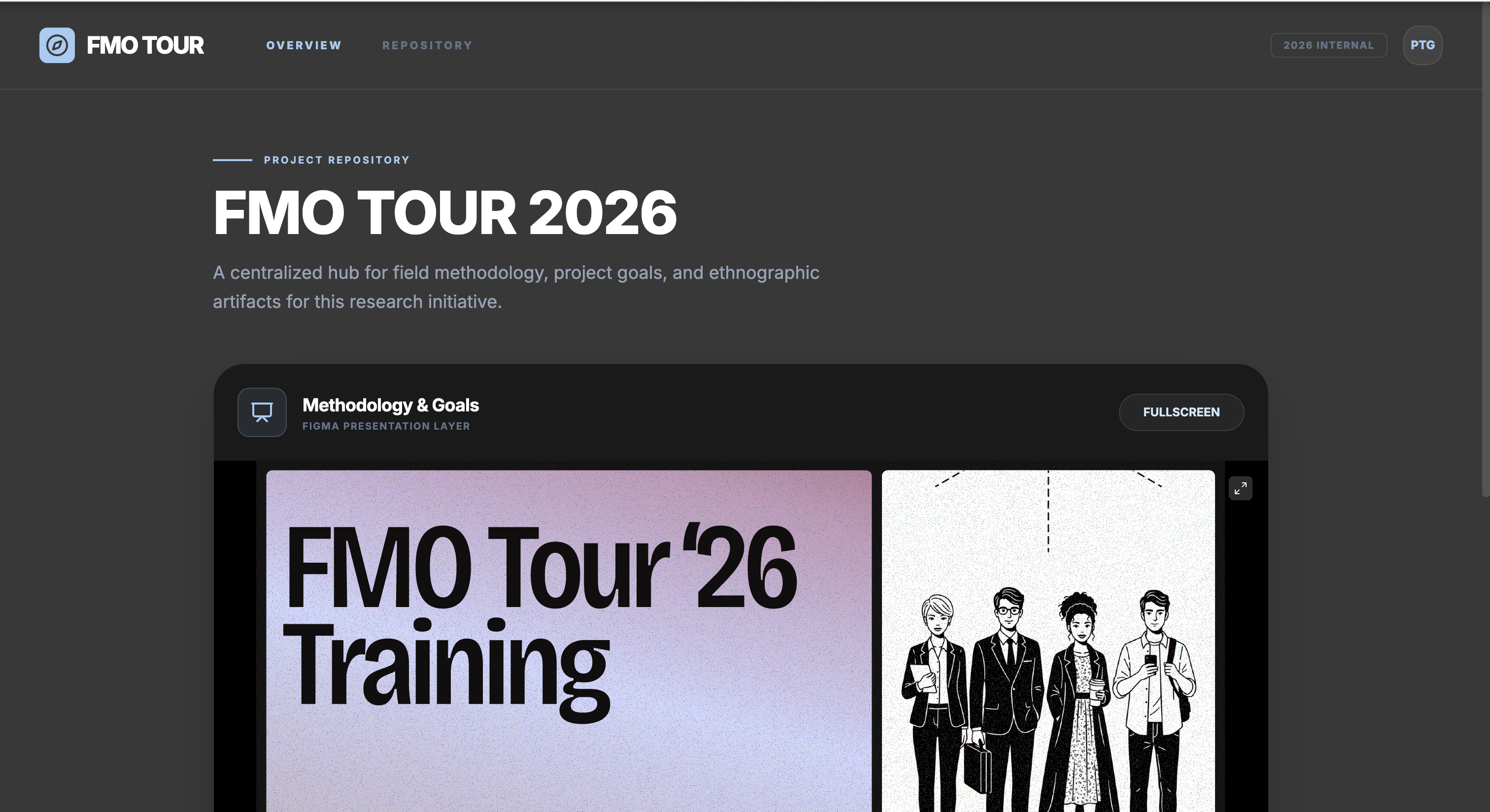
Overview
Follow-Me-to-the-Office (FMO) is an ethnographic research method where cross-functional pods embed inside accounting firms during the busiest weeks of tax season. Over the course of 4-hour observation sessions, teams act as “flies on the wall” — watching tax professionals navigate real client work, tool ecosystems, and team hand-offs without interference.
Our goal was to see the work as it actually happens. We wanted to validate assumptions about data input workflows, tool integration, staff roles, and workflow gaps within the Large Firm segment — insights that interviews and surveys alone could never surface.
The Challenge
How might we validate our assumptions about tax professional workflows by observing real behavior during their most high-stakes, time-pressured period?
Prior research relied on interviews and self-reported data, which tend to miss the workarounds, informal processes, and sheer chaos of peak tax season. We needed an in-context, real-time method that would capture behaviors professionals themselves might not think to mention — the things they do on autopilot, the tools they cobble together, the friction they have long accepted as normal.
Planning & Preparation
Months before the first visit, I led the end-to-end planning effort — from participant recruitment to team training to building a centralized research hub. The scale of the initiative (15 team members, multiple firms, nationwide travel) demanded rigorous preparation.
Firm screening & recruitment
Used a segmentation tool to identify Multi-Service Firms of varying sizes and workflows. Designed screener surveys and conducted 15-minute pre-visit calls to assess fit and set expectations.
Team assembly & training
Ran a 1-hour mandatory protocol training for ~15 researchers, designers, PMs, and engineers covering ethnographic observation methods, role assignments, and do's and don'ts for field behavior.
Guide & artifact creation
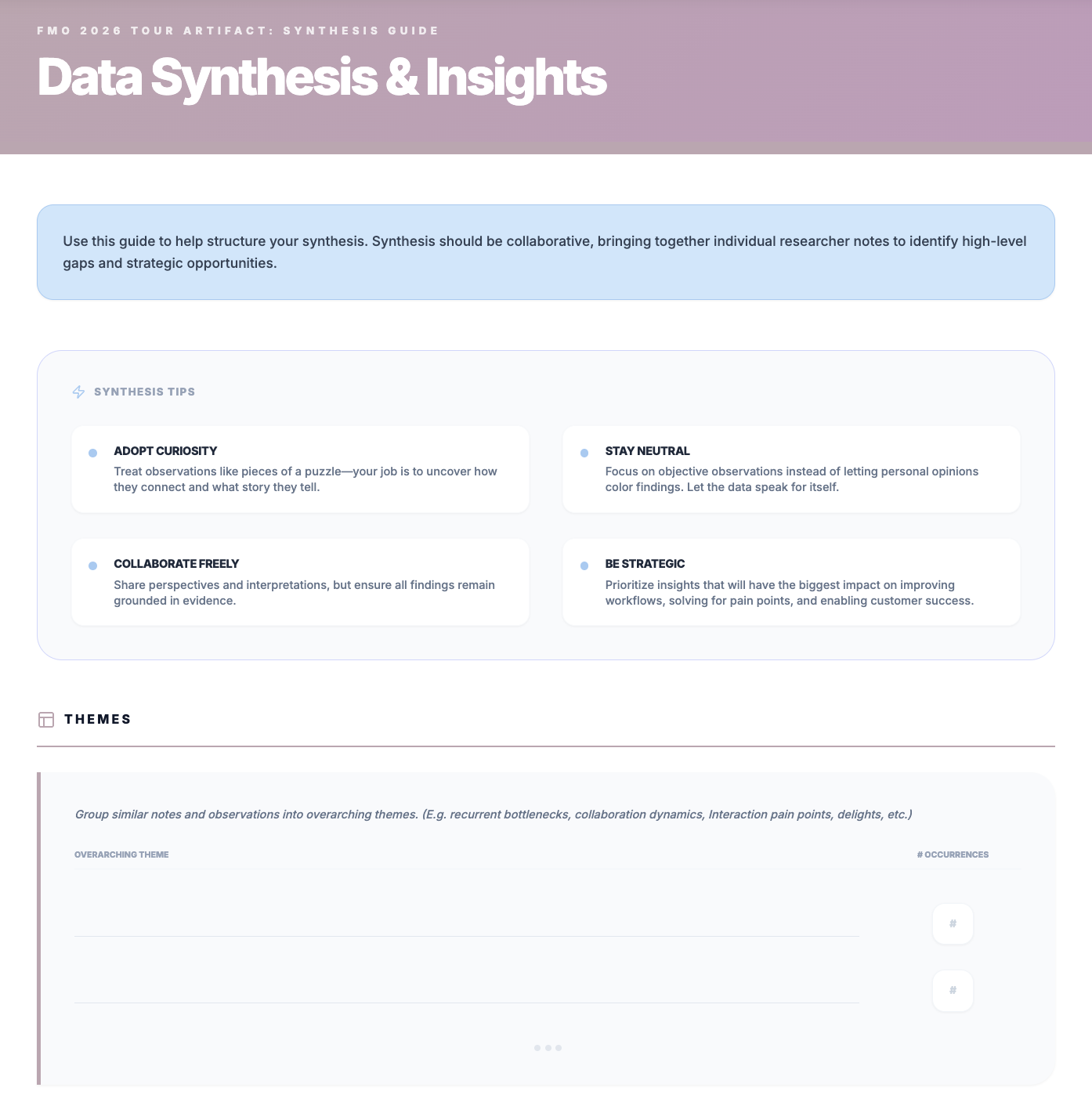
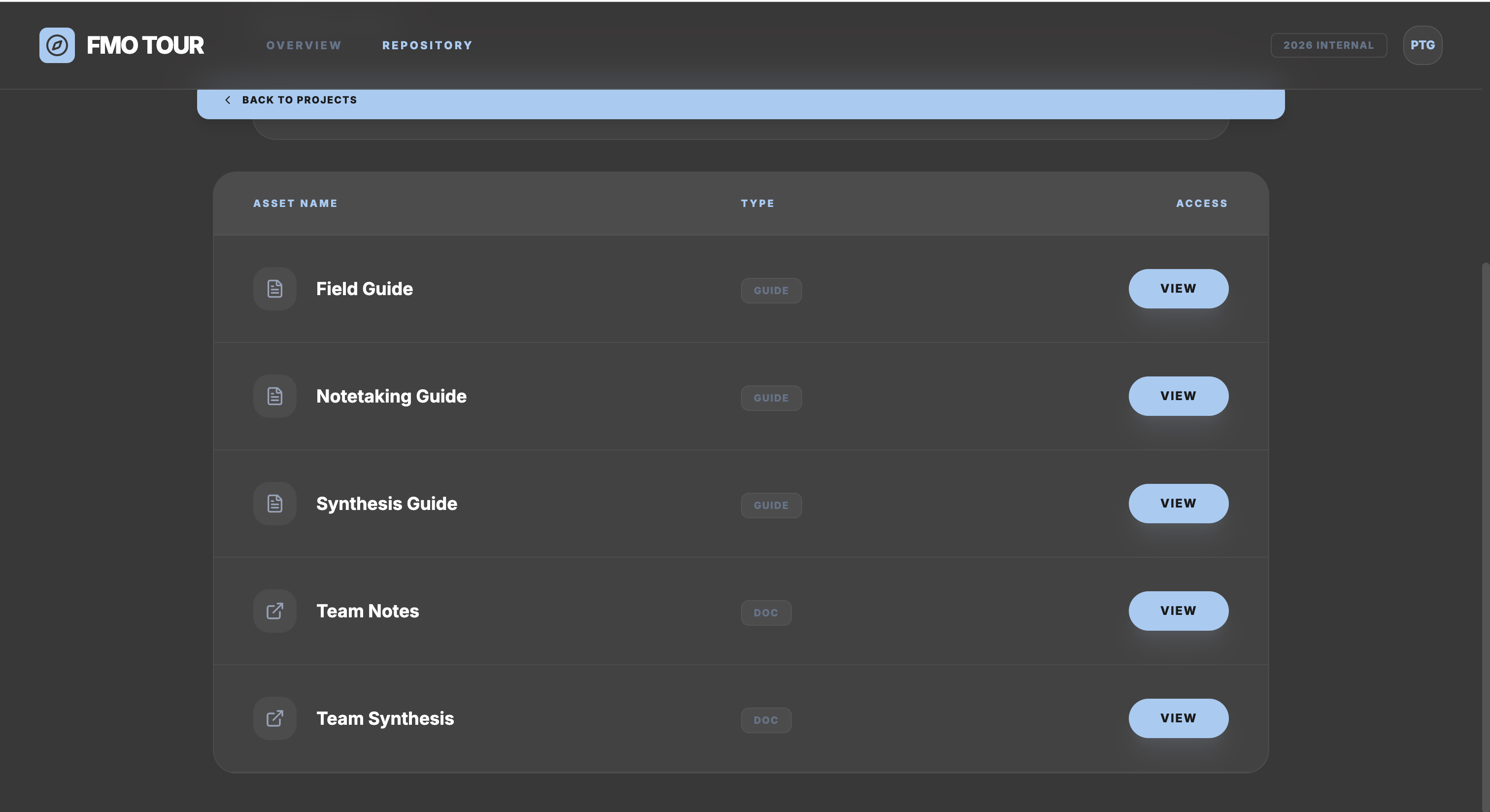
Created a comprehensive field guide, standardized notetaking templates, a synthesis framework, and an FAQ document. Built the FMO Tour hub on GitHub to centralize all methodology docs and artifacts.
Logistics coordination
Organized travel for cross-functional pods to firm locations across Texas, New York, and Idaho, coordinating schedules with participants during their busiest period.
In the Field
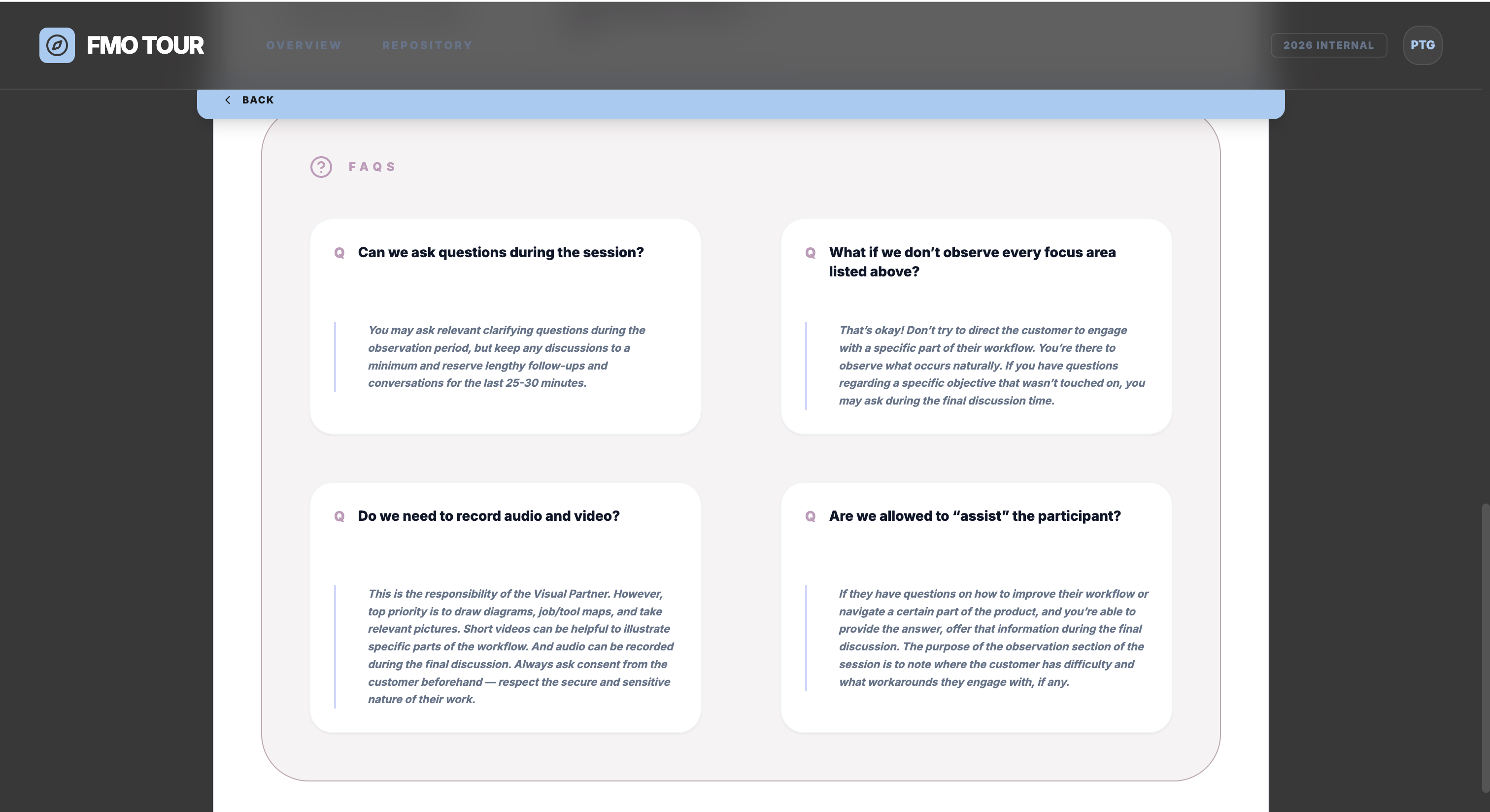
Each visit deployed a pod of 3–4 team members to a firm's office for a 4-hour observation window. We watched tax professionals process returns, manage client communication, reconcile data across systems, and navigate the multi-tool workflows that define their daily reality — all during the most high-pressure weeks of tax season.
Every pod member had a defined role: a conversation leader who served as primary liaison, two notetakers capturing detailed, neutral observations, and a visual partner sketching workflow diagrams and photographing the physical environment. This structure ensured consistent, thorough documentation across all sessions.
Synthesis
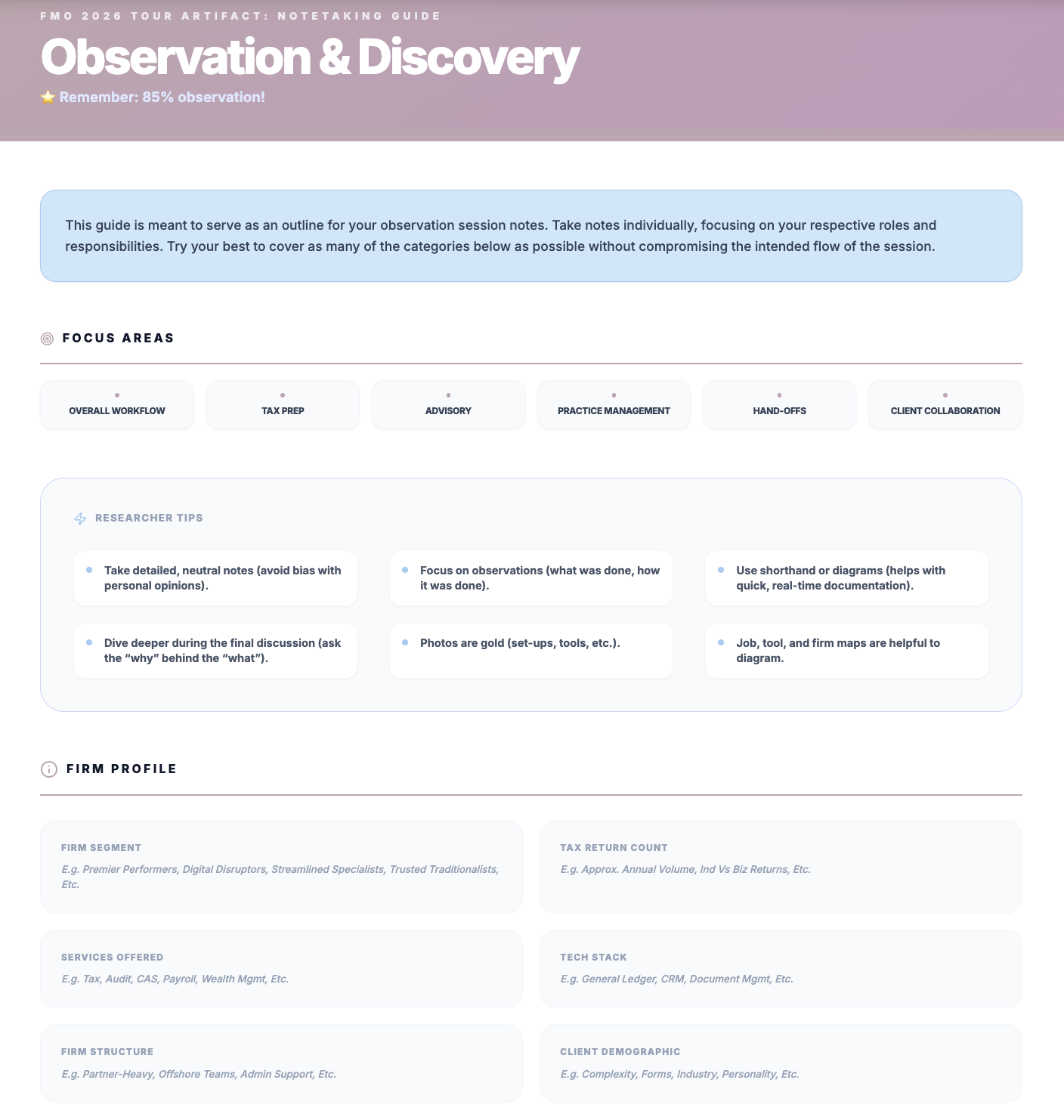
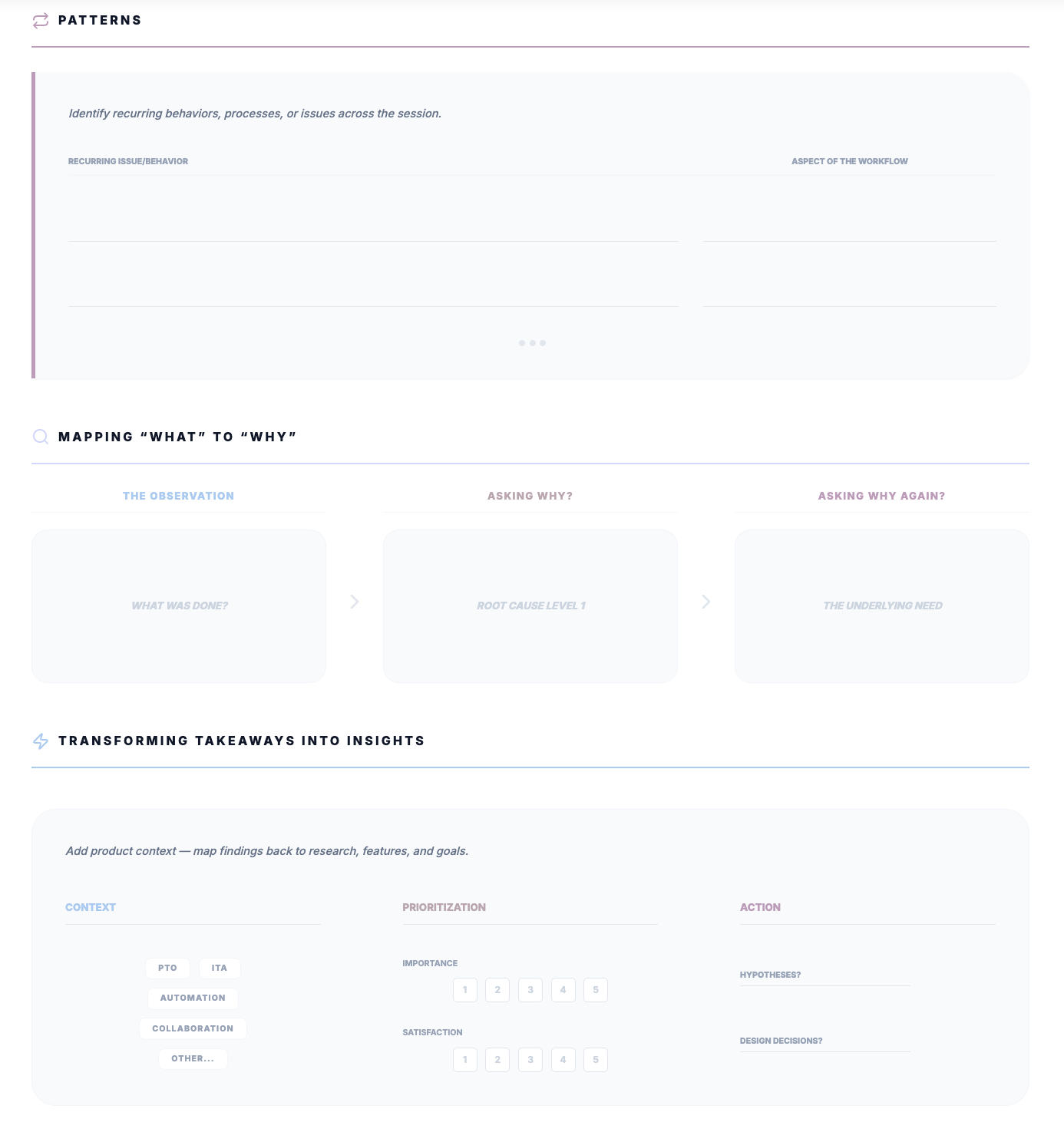
After field visits concluded, each pod moved into collaborative synthesis using the standardized framework I designed. Teams coded their observations into themes, identified recurring patterns, and mapped surface-level behaviors to underlying root causes using a structured “What to Why” methodology.
The cross-functional team composition paid off here — designers noticed UI friction that researchers might overlook, PMs connected observations to roadmap priorities, and researchers anchored everything in behavioral evidence. Each lens enriched the analysis.
Research Artifacts
To support the initiative at scale, I designed and built the FMO Tour hub — a centralized repository housing all methodology documentation, from the field guide and notetaking templates to team synthesis outputs. This gave every team member a single source of truth before, during, and after their sessions.
Key Findings
Across all sessions, six recurring themes emerged — each validated by direct observation rather than self-report.
Cross-product fragmentation
Every firm we observed operated across 4–6+ disconnected tools simultaneously. Tax software, accounting platforms, spreadsheets, practice management tools, and communication apps all played a role in completing a single return — with no unified data flow between them.
He navigated between six browser tabs, copy-pasting between three different systems for a single return.
Excel as the system of record
Preparers and reviewers consistently relied on Excel for calculations, allocations, and validation rather than their tax software. The software served primarily as a filing engine — the real analytical work happened in spreadsheets they built themselves.
"I trust my spreadsheet. The software is just where I file from."
Manual workarounds everywhere
We observed extensive "human API" behavior — professionals manually copying data between tools, re-entering information that should have synced automatically, and building elaborate personal systems to compensate for gaps between platforms.
Trust requires transparency
When tax software produced calculations, professionals couldn't trace how a number was derived. Without calculation lineage, they defaulted to verifying everything manually — sometimes using physical calculators alongside their monitors.
The difference in tax calculated could not be resolved, leading to a lack of trust.
Knowledge lives in people, not tools
Experienced professionals relied heavily on memory and domain expertise rather than system guidance to complete their work. This made their workflows nearly impossible to delegate or scale — institutional knowledge lived in their heads, not in any tool.
AI as thought partner, not automator
Firms that had adopted AI tools like ChatGPT or Claude used them primarily for drafting client communications and light tax research — never for core tax calculations or decision-making. AI served as an assistant to enhance their interpersonal strengths, not replace their expertise.
"I try not to use it too much because I don't want to become dumb."
Impact & Reflections
The FMO sessions gave our product organization something surveys and interviews never could — direct observation of the messiness, creativity, and friction in real tax workflows during the highest-stakes period of the year. Seeing a professional toggle between six tools to complete one return, or build an entire parallel system in Excel because they didn't trust the software's math, communicated the urgency of these problems in ways that data alone could not.
Findings directly informed the product strategy for the Large Firm segment, validating some existing assumptions while invalidating others. The cross-product fragmentation theme, in particular, reshaped how the team thinks about workflow integration across the Intuit ecosystem. Seeing is believing — stakeholders who attended sessions firsthand became the strongest advocates for change.
For me personally, this study reinforced the irreplaceable value of ethnographic methods. There are things you can only learn by being in the room — the background conversations, the physical environment, the split-second decisions that reveal how someone really works. Bringing cross-functional partners into the field alongside researchers multiplied that impact.
Why this method matters:
Bringing designers and PMs into the field alongside researchers created shared empathy that no readout deck could replicate. Team members who observed sessions firsthand became the strongest champions for the workflow changes our findings supported.